Short answer: a prompt whose honest answer is advice rather than a list of providers cannot be won. When it comes back with no brands in it, your scan records a brand-absent result — which every metric scores exactly like losing to a competitor. Five checks catch most of these, and they apply whether your prompt set was generated or hand-written.
Most advice about AI visibility prompt sets is about coverage: which buyer questions, which decision stages, which personas. That's the right place to start, and we've written the long version of it.
This is about the other failure, the one that doesn't look like a failure. A prompt can be fluent, on-topic, grounded in your actual category, and still be impossible to win. It sits in your set for months, comes back empty every time, and drags a number nobody can explain.
Why an unwinnable prompt is worse than no prompt
A visibility score is built on how often you're mentioned across the questions you track. When an answer doesn't name you, that's a data point, and it belongs in the denominator — that's the whole point of the measurement.
But scoring can't distinguish two very different reasons for an empty answer. One is that a competitor got named and you didn't. The other is that the question had no companies in its answer at all. The first is a loss you can act on. The second is noise you added yourself.
Add enough of the second kind and your score becomes a number about your prompt set rather than about your market.
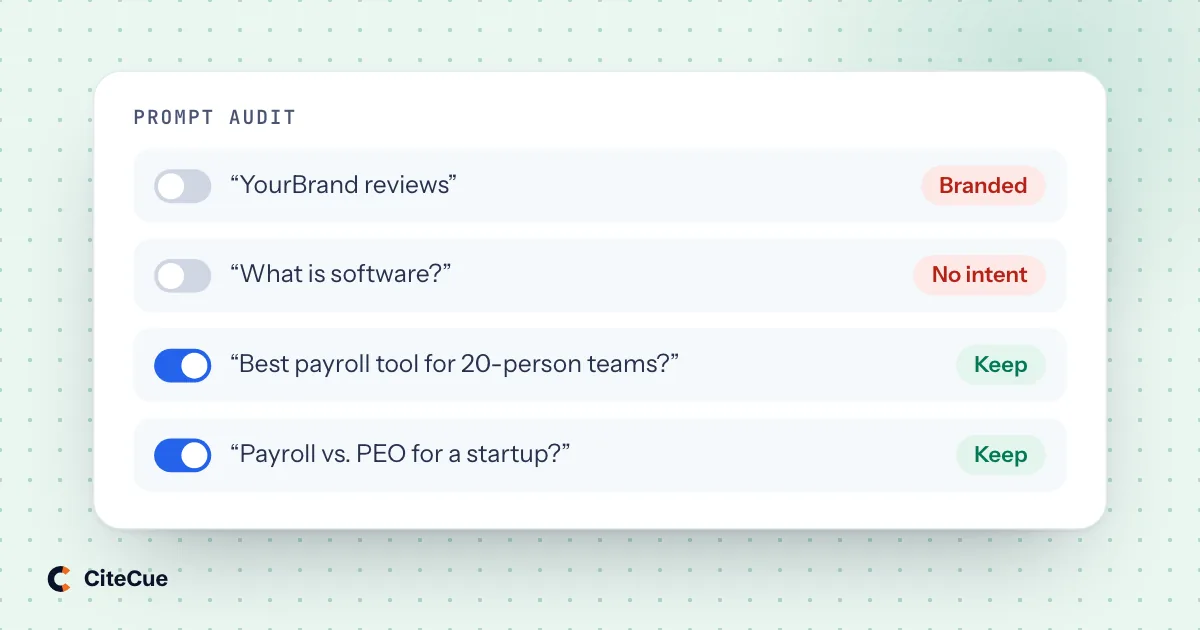
Test 1: picture the answer. Would it name real companies?
This is the one that catches the largest family. Read the question, imagine the best possible answer to it, and ask whether that answer would list two or three actual businesses. If it wouldn't, tracking the question tells you nothing.
Three shapes that fail it, all of them real examples from our own testing:
- "How can we catch AI-generated misinformation before it reaches prospects?" — eleven words, names no brand, perfectly on-topic. Its honest answer is advice.
- "Should I buy an AI search platform or build reporting in-house?" — a genuine buying question, but one branch of that choice is something nobody sells. The answer is a budget essay.
- Anything encyclopedic. "What is answer engine optimization?" is a fine thing to publish about and a useless thing to track, because the answer names nobody.
Note what this test is not. It is not "the question must ask for a recommendation." We used to state the rule that way and it was actively harmful: it disqualified every how-to, which pushed vendor vocabulary into questions nobody actually types, and it threw away the strongest signal available — a real problem, plainly stated, whose natural answer happens to be a list of products. "My team keeps missing contractor payments in three countries" is a problem statement, not a request for a vendor, and a good answer to it names vendors.
The bar is what the answer looks like, not what the question sounds like.
One trap when you apply this yourself: imagining the companies an answer would name is the test, but those names must not end up in the question. That's the next two tests.
Test 2: is this your marketing copy with a question mark on it?
Here's a question that looks great and is quietly rigged:
what AI visibility tool can flag incorrect brand answers quickly?
That's a feature bullet. Somebody read a product description and converted a differentiator into a question. It will do well — because a question phrased in your own vocabulary is one that only you answer well. It manufactures the recommendation it claims to measure.
The correction is to read your own positioning for the customer's situation rather than its wording. What problem does that feature solve, and how would somebody who has never heard of you describe having it? That's the question worth tracking.
Test 3: does the question name you?
A question that names your brand very nearly guarantees the answer repeats it. Mention detection cannot tell a self-fulfilling mention from an earned one — nor should it, since it's looking at text. So one brand name leaking into a discovery question inflates your headline number for as long as that prompt is tracked.
There is one place branded questions belong, and it's an important one: evaluation. "How does Brand A compare with Brand B for a finance team?" exists precisely to see how you're described when you're already in the conversation — the tone, the caveats, the sentiment. That's real signal about your reputation, and you can't get it any other way.
What matters is the share. Branded questions answer "what do they say about us"; unbranded ones answer "do they find us at all", and the second question is the one you're paying to have answered. CiteCue's default mix moved evaluation from 30% down to 20% of a generated set, so roughly four in five of your prompts are measuring unprompted discovery. Small sets round the branded share away first, which is the right way round: with ten prompts you want discovery, not commentary.
Test 4: will this question mean the same thing next month?
"Near me", "nearby", "in my area". These are the most natural way a human phrases a local question and the worst way to phrase a tracked one. A scan replays your questions through provider APIs whose location steering is country-level at best, so the answer can't be local. It's not that you get a wrong result — you get an empty one, permanently.
Name the place. "Best physiotherapist in Bratislava" is measurable; "best physiotherapist near me" is not. Same reasoning applies to relative time: "today" and "this year" quietly change what the question means every time it runs.
Test 5: is that four prompts, or one prompt four ways?
Exact-match deduplication doesn't help here, because four rephrasings of one question are four different strings. If your set contains "best CRM for a small business", "what CRM should a small business use", "top CRM options for small businesses" and "which CRM works best for small companies", you are measuring one thing four times and reporting it as four-fold coverage.
The judgement call is where similarity stops being duplication. CiteCue merges drafts above roughly 70% content-word overlap and keeps everything below it. "Best CRM for small teams" and "best CRM for remote teams" sit just under that line and stay separate — deliberately, because those are different buyers and the answers genuinely differ.
If you're auditing a set by hand, the useful question isn't "are these worded differently?" but "would I expect a different list of companies back?"
How CiteCue enforces this on generated sets
CiteCue builds a starting prompt set from your site's AI context — what you sell, to whom, in what category. It doesn't have access to the questions your buyers actually typed into an assistant; nobody does. So the quality of the generation is the quality of the starting set, and for a while ours was worse than its instructions.
That gap turned out to be the whole lesson. Every rule above was already written into the generation instructions, and the model was quietly dropping the soft ones under the weight of the other ten. A rule the model reads is advisory. A rule the pipeline enforces is a guarantee.
So generation now over-produces drafts and narrows them in code:
- Hard rejects, for what's objectively checkable and makes a prompt wrong to track: an answer shape that explains rather than recommends, a question outside a sane length band, relative location phrasing, and your brand or a competitor's name leaking into a discovery question.
- Scores, for everything that's a matter of degree: length inside the band, how specific the question is to your category, how similar it is to the rest of the batch. These reorder the set rather than emptying it, because a single wrong judgement should cost a draft its place, not its existence.
- A separate critic rates what code can't judge, and its worst rating is now a rejection rather than a nudge.
- Its own model tier. Prompt generation runs a handful of times per project and determines every metric downstream, so it's the last place to economize — it no longer shares the cheap model used for bulk answer analysis.
You can also add your own prompts at any time, and mining Search Console for queries you already earn impressions on is the best source of proven demand. Generated prompts explore categories where you have no visibility yet, which is exactly what first-party data can't show you — you were never there to be measured.
What no gate can fix
A dud prompt still counts. A question whose answers name no brands at all sits in the denominator exactly like one a competitor won. We report around that rather than scoring around it — the Overview in AI prompt monitoring separates unbranded from branded visibility so you can see which half is moving — because quietly dropping prompts from the denominator would break every comparison against your own history.
Zero mentions is a valid result. If your unbranded prompts come back with no mention of you, the set isn't broken. That's the finding, and it's the one the whole product exists to report. The next step is why, not a regenerated prompt list.
No rule knows your buyers. These five tests remove prompts that cannot be won. They can't tell you which winnable questions matter to your business. That judgement is still yours, and it's the part worth spending an afternoon on.