To test whether a content change improves AI visibility, define one intervention and one primary outcome, choose comparable page groups, and measure both groups before and after publication. Keep prompts and collection conditions stable, inspect which page versions became available, and review the full answers. A comparison group helps interpret movement; its usefulness depends on how the groups were chosen and what else changed.
A team adds a clearer explanation to several pages and sees more citations in the next scan. That is a reason to investigate. It leaves a question unanswered: would those pages have gained citations without the edit?
The AI visibility metrics guide explains which outcomes to monitor. This article has a different job: designing a prospective test that makes a particular editorial decision easier to assess. The method below is a practical application of experimental-design principles to public content, not a documented ranking formula or a report of CiteCue customer results.
Write a decision and a testable intervention
Start with the decision the result will inform. “Should we add a worked implementation example to the remaining integration guides?” is specific enough to test. “Does AEO work?” leaves too many possible changes and outcomes bundled together.
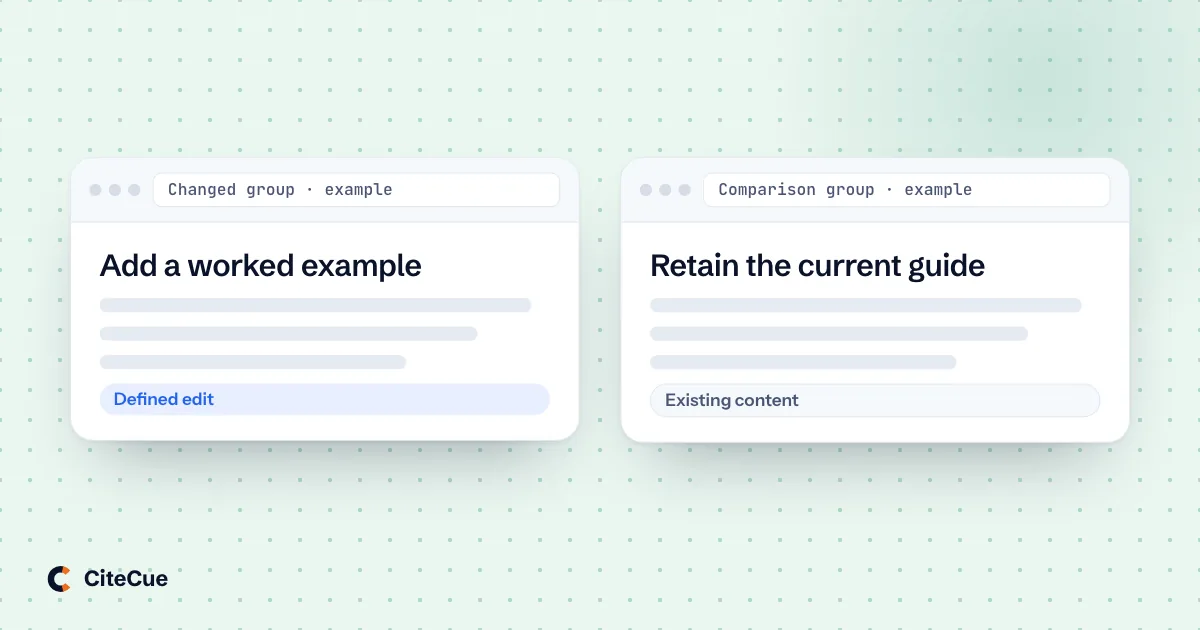
Specify the edit in terms another editor can reproduce. For example, add a factual implementation example with prerequisites and a supported limitation to selected guides. Keep the existing URLs and avoid simultaneously rewriting titles, adding links across the whole site, and launching a promotion. A bundled release can still be assessed, but the result concerns that package rather than any one ingredient.
NIST's guide to selecting an experimental design distinguishes comparative objectives from screening and optimization objectives. Our recommendation for a first content test is a narrow comparative question: does this defined change help on this outcome within this scope?
Save a brief before publication:
| Field | What to decide |
|---|---|
| Decision | Which rollout or editorial choice the test informs |
| Intervention | The exact change and what counts as successfully publishing it |
| Eligible pages | Which pages could receive that change and why |
| Primary outcome | A result close to the edit, such as supported citations to the relevant guide |
| Assignment | How pages or page groups enter the changed and comparison groups |
| Collection | Prompts, engine or surface, locale, settings, schedule, and planned window |
| Review | Scoring rules, missing-data handling, end condition, and owner |
Choose secondary observations in advance too. A better citation result alongside new factual errors would be a different editorial decision from a clean improvement.
Assign pages rather than relabelling prompts as independent tests
The intervention happens to a page or a group of pages. Asking many paraphrases about one edited guide does not create many independently edited guides. Keep the assignment unit explicit when collecting results and discussing uncertainty.
Where feasible, group eligible pages by relevant baseline characteristics, such as content purpose, topic, language, and prior citation pattern. Randomly assign pages within those groups to receive the edit or remain unchanged during the observation window. Save the eligible list and assignment, including the method used to make it.
NIST's randomized-block design guidance describes grouping similar experimental units to account for important nuisance factors, with randomization used for remaining variation. Applying that idea to content is our design recommendation. Similar topics and baseline readings help make a comparison interpretable; they do not establish that the groups are identical.
If shared templates or overlapping source topics make page-level assignment impractical, consider assigning whole page clusters. An edit to a common template can affect every page using it. A rewritten overview can also become a source for questions originally mapped to another guide. Document these possible spillovers and inspect cross-group citations during the review.
If business priorities require editing only the weakest pages, record that selection honestly. Comparing them with the strongest untouched pages is an observational comparison with an obvious selection difference. Random assignment is a real design choice: NIST's completely randomized designs describe assigning treatment levels to experimental units at random. Merely calling an untouched group a control does not create that property.
When the site has too few suitable pages, use a documented before-and-after case study. It can inform the next decision while retaining a clear limit on attribution.
Freeze the question panel and define how answers are scored
Map the questions to the page or cluster they are intended to evaluate before editing. Use the prompt-selection guide to keep them relevant to real reader decisions. These are configured diagnostic questions, not evidence of how often customers ask them.
Keep the wording, locale, collection surface, available settings, and schedule comparable across the baseline and follow-up. Run changed and comparison groups during the same collection windows, and alternate or randomize their order where your collection setup permits it. Avoid collecting all baseline observations under one setup and all follow-up observations under another.
Define a primary outcome precisely. For a test of implementation examples, a useful candidate is a supported citation to a predeclared relevant guide: the answer links to that guide and the cited material supports the claim being reviewed. A brand mention and a citation to an unrelated page do not meet that definition.
Write down the denominator and classifications. A completed response with no relevant citation can be an observed non-hit. A connection failure is an unavailable observation. A refusal is a completed response whose treatment should be specified in the scoring rules. Report unavailable observations by group and period; silently losing more requests in one group can change the comparison.
Have reviewers use the same rubric, and hide assignment labels during scoring when practical. Preserve disputed assessments and their reasons. CiteCue's Prompts Monitoring retains the full responses to tracked questions, giving a reviewer more to assess than a headline score. Keep the experimental assignments and custom rubric in the study record alongside those responses.
Verify the published treatment and record uncertainty about exposure
Save the original pages and the exact published changes. Check production URLs, readable text, links, and relevant metadata immediately after release. Record deployment time, public verification time, and any later correction. Coordinate with everyone publishing content or automated fixes so an unrelated release does not quietly change the comparison pages.
For this design, each assigned page can receive an ordinary public edit while the comparison pages retain their existing content. That differs from a browser conversion test that switches versions for visitors. Google's website-testing guidance warns against showing different URLs to Googlebot and humans, explains that Googlebot generally does not support cookies, and gives canonical and temporary-redirect guidance for tests using alternate URLs. Follow the requirements matching your implementation if you introduce that kind of variation.
Public availability is one observation. Whether a particular answer used the revised material is another. Google's generative AI search guidance states that pages must meet its indexing and snippet eligibility requirements and that crawling, indexing, and serving are not guaranteed. Do not assume a universal exposure delay across answer engines.
Keep delivery and index evidence beside the answer observations. A log request can help investigate access, while an answer quoting a newly added passage may provide more specific evidence of that passage appearing in the response. Neither establishes exposure for every observation in the panel.
Keep the assigned pages in the main comparison even when a recrawl is unconfirmed, and explain the exposure uncertainty. Removing unsuccessful pages after seeing the results changes the question being evaluated. Any additional analysis limited to confirmed cases should be labelled separately, with its selection rule disclosed.
Compare changes in both groups before explaining a result
Summarize results at the assigned page or cluster level so a page with many prompt variants does not silently dominate. Choose the aggregation and weighting before inspecting the follow-up results. Retain the underlying counts, completed responses, and missing observations for each period.
A descriptive comparison can use this arithmetic:
difference in changes = (changed-group after − changed-group before) − (comparison-group after − comparison-group before)
For percentage-based outcomes, express that difference in percentage points. This calculation summarizes movement; by itself it does not establish a causal effect. Interpretation depends on assignment, baseline comparability, missing data, exposure, and possible interference between groups.
Use the pattern to guide the review:
| Observed pattern | What to investigate |
|---|---|
| Both groups improve similarly | Shared conditions may explain much of the movement |
| Changed pages improve while comparison pages remain stable | Inspect assignment quality, actual sources, and competing explanations |
| Citation counts improve but claims become less accurate | The primary score may conceal a quality problem |
| One page drives most of the movement | Examine that page and the distribution across assigned units |
| Delivery fails or missing responses differ materially | The planned comparison may be inconclusive |
These are interpretation prompts, not reported study findings. You do not control an answer engine's updates, other publishers, or every source it selects. A comparison group helps reveal some shared movement, but it cannot automatically absorb every change affecting the treated topics.
For a formal uncertainty interval or significance claim, use analysis appropriate to the assignment unit and repeated observations. Do not treat all prompt responses as independent samples merely because they occupy separate rows. A universal sample-size threshold would ignore the design and baseline variability; plan the analysis with someone qualified when the decision requires statistical inference.
End with a bounded rollout decision and a reproducible record
Review at the planned endpoint rather than stopping at the first favorable scan. If collection fails or you extend the window, record why and distinguish that extension from the original plan. Correct urgent factual errors when needed, and log their effect on the test's scope.
Decide whether to extend the edit, revise it, repeat the study, or retain the page improvement without claiming a visibility effect. An implementation example may help readers even when the answer evidence remains inconclusive. Describe that editorial benefit using evidence appropriate to it.
Use CiteCue's content fix workflow to prioritize a confirmed gap and connect the proposed change to its rationale. Keep the experiment brief, page assignments, release record, raw answers, scoring decisions, and comparison results together so the next reviewer can reconstruct the decision.
A defensible report states which pages changed, how they were selected, what was observed in each group, what disrupted collection, and what the evidence supports doing next. That gives the team a useful answer to a specific publishing question without turning one favorable scan into a general optimization claim.