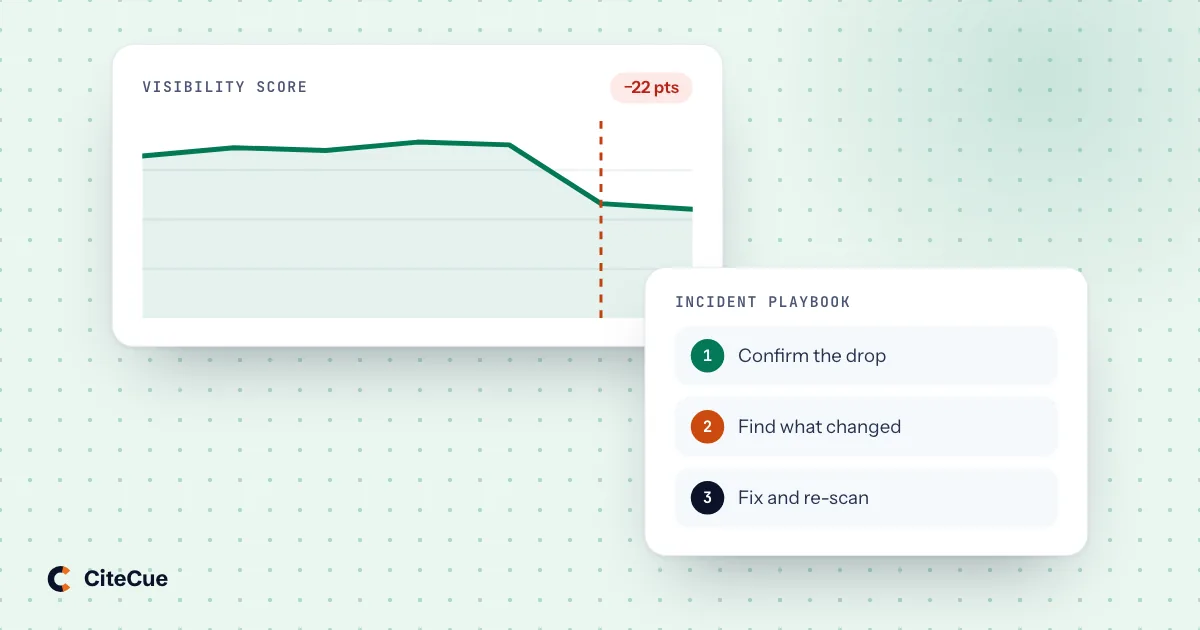
When AI visibility drops, do not start by publishing more content. First confirm that the decline is repeatable, preserve the affected answers, check whether the measurement scope changed, and test technical access. Then compare lost citations, source pages, competitors, and recent site changes. Treat each explanation as a hypothesis until the same evidence supports it across several comparable scans.
AI answers vary. A brand can appear in one response and disappear from the next without any change to its site. That normal variation makes a sudden chart movement difficult to interpret: it may be an actual loss, a narrow sample, a technical failure, or a reporting change.
An incident process keeps the team from making a second problem while reacting to the first. It establishes what moved, how far the effect reaches, which evidence still exists, and what must recover before the incident can close.
Decide whether the drop is an incident
A single missing mention is an observation, not an incident. Escalate when the change is material to your business and repeats within a stable measurement scope.
Define thresholds around your own prompt set, scan cadence, and risk tolerance. A small team might open an incident when a high-intent product comparison loses the brand across three scheduled scans. A larger program might require a sustained decline across a prompt cluster, market, or engine. There is no universal percentage that separates normal answer variation from a real loss.
Use a simple severity model and adapt it to your operation:
| Level | Example trigger | First response |
|---|---|---|
| Critical | A confirmed technical block affects most important pages, or a prominent answer repeats a harmful false claim | Involve the site owner and brand lead immediately; preserve the evidence |
| Major | Several engines or a business-critical prompt cluster decline across comparable scans | Open an investigation with a named owner and change freeze |
| Minor | One prompt, locale, or engine moves while the broader set remains stable | Watch the next scheduled scans and inspect the individual answer |
Severity should reflect likely business impact as well as chart size. Losing one branded buying question can matter more than losing ten broad informational prompts. A false statement about safety, eligibility, or pricing may also require a faster response than a neutral omission. Sentiment & Brand Risk keeps the wording of those claims visible so the brand team can judge the risk instead of inferring it from a score.
Preserve the evidence before changing the site
Capture the incident as it appeared. AI answers can change, dashboards can aggregate new data, and a later scan cannot recreate the exact state you are investigating.
Save these fields for every affected result:
- exact prompt, engine, model or surface when available, locale, and scan time;
- full answer text, brand position, sentiment, and every cited source;
- expected page or fact that was absent;
- previous comparable answers and their cited URLs;
- the numerator and denominator behind the changed rate;
- site releases, redirects, content edits, and crawler-control changes near the first decline.
Keep the unaffected control group too. Prompts that stayed stable help narrow the cause. If product prompts dropped while support prompts did not, investigate the product pages and their source ecosystem before treating the whole domain as impaired.
Prompts Monitoring records the question, engine, answer, date, mention, and cited sources together. Export or snapshot the affected runs and link them from the incident record. The goal is a reproducible case, not a screenshot of one falling line.
Check the measurement scope first
Before assigning a site cause, verify that the two periods measure the same thing. A metric can fall because its denominator expanded, prompts were edited, a market was added, or an engine stopped returning eligible answers.
Compare the baseline and incident windows field by field:
| Scope check | Questions to answer |
|---|---|
| Prompt inventory | Were prompts added, removed, rewritten, or moved between groups? |
| Platform coverage | Are the same engines and answer surfaces included? |
| Market and language | Are country, language, and location settings unchanged? |
| Schedule | Did scan frequency or the comparison window change? |
| Eligibility | Did failed, refused, or noncommercial answers enter the denominator? |
| URL normalization | Are redirects, query strings, and canonical variants splitting one page? |
Use raw counts beside rates. “Citation rate fell from one week to the next” is incomplete without the number of answers and citations in each period.
Also respect the limits of each external report. Microsoft's current AI Performance documentation says its citation data is aggregated across supported AI surfaces. It explicitly says page-level citation counts do not indicate a page's importance, rank, or placement in an individual answer, and that grounding-query data is a sample. Use that report to confirm patterns within its stated scope, not to reconstruct an answer it does not expose.
If the decline disappears after the scope is aligned, record it as a measurement change. Do not open an editorial project to repair a denominator.
Triage technical reachability and indexing
When the scope is stable, test whether engines can still reach the pages that used to support the answers. Start with the affected URLs rather than auditing the entire site.
For each page:
- Request the canonical URL as an anonymous visitor and confirm a useful
200response. - Follow redirects and verify they end on the intended page.
- Inspect
robots.txt, robots meta tags,X-Robots-Tag, canonical tags, and authentication or consent gates. - Check that the main answer content exists in the returned HTML and is not hidden behind a failed script.
- Confirm the URL remains in the intended sitemap and internal-link path.
- Review CDN, firewall, bot-management, and server logs for blocked or failing crawler requests.
- Check the indexing state and recent crawl evidence in the relevant webmaster tools.
Google's guidance for AI features says a page must be indexed and eligible to appear in Google Search with a snippet before it can be shown as a supporting link in AI Overviews or AI Mode. It also recommends checking crawler access, internal links, textual availability, and Search Console. Meeting those requirements makes a page eligible; it does not guarantee that Google will crawl, index, or serve it.
For ChatGPT search, OpenAI's current publisher FAQ tells publishers to allow OAI-SearchBot if they want content included in summaries and snippets. Test the specific crawler and affected route. A rule that allows one search crawler does not establish access for every AI service.
AI Readiness brings crawler access, sitemap coverage, index status, and AI-referral checks into the same review. Use the result to identify a concrete failure, then confirm it at the URL, configuration, and log level before changing production controls.
Compare the sources and pages that changed
If access and indexing are healthy, look at what replaced you. Group the lost answers by prompt purpose, then compare their earlier and current source sets.
Ask four questions:
- Was the same page cited before? If so, inspect edits, deleted sections, changed claims, canonicals, and freshness since the last stable scan.
- Did a different page from your site take its place? This can be a page-selection issue rather than a domain-wide loss.
- Did competitors gain the missing citations? Review the exact evidence their cited pages provide: specifications, primary data, clear comparisons, current policies, or independent corroboration.
- Did the answer stop citing any commercial source? The result format or intent may have changed, so a new sales page will not necessarily address the loss.
Do not copy a competitor's article structure and call that root-cause analysis. Identify the useful evidence the current sources contain and whether your site has an accurate, first-party reason to add it. Sometimes the right response is updating a stale product page. Sometimes it is correcting inconsistent facts across documentation and trusted third-party profiles. Sometimes there is no justified content change.
Citations & Competitors helps map which domains and pages appear in the affected answers. Connect that source evidence to the site change log. A competitor gaining citations in the same week you changed a page is correlation until the answer history, page differences, and repeated scans support a narrower explanation.
Build hypotheses, then choose the smallest useful fix
Write each proposed cause in a testable form:
We believe product-comparison prompts lost citations because the old buying guide now redirects to a generic category page. We expect restoring an equivalent canonical guide and internal links to produce successful crawler responses first, then renewed eligibility and possible citation recovery in later comparable scans.
That format separates the observation, evidence, intervention, and expected signal. It also prevents a team from treating “publish more content” as a diagnosis.
Use one owner and one verification plan per confirmed gap. Examples include:
| Evidence | Smallest useful response | Immediate verification |
|---|---|---|
Important pages return 403 to a search crawler |
Correct the scoped firewall or crawler rule | Fetch the exact URLs and inspect logs |
| A migration removed the cited URL without an equivalent redirect | Restore or redirect to the closest valid replacement | Test the redirect, canonical, sitemap, and internal links |
| Pricing facts conflict across product and help pages | Establish one canonical fact and update inconsistent first-party pages | Re-crawl the affected pages and review rendered text |
| Competitors are cited for evidence your page does not provide | Add accurate, decision-useful evidence to the appropriate existing page | Editorial and factual review of the shipped section |
| One answer changed while its prompt cluster stayed stable | No immediate site change | Observe the next comparable scans |
Put confirmed content gaps into a delivery queue. Content Fixes can organize them by the missing factor and later scan, but keep technical repairs, measurement changes, and reputation responses labeled separately. They have different owners and completion criteria.
Verify recovery without claiming more than the evidence proves
Technical fixes have immediate checks: a crawler can receive the page, the redirect resolves, the canonical is correct, and the content renders. Citation recovery is slower and less deterministic. No site change guarantees inclusion in a generated answer.
Re-run the same prompt panel, engines, locales, and denominator across several scheduled scans. Review:
- raw mentions and citations as well as rates;
- the affected cluster and an unaffected control group;
- the cited URL, not only the domain;
- recurrence across runs, not one favorable answer;
- technical health throughout the observation window.
Close the incident when the defined recovery condition is met or the evidence shows that the movement was normal variation. If the fix is technically verified but citations have not returned, keep those facts separate. “The page is reachable again” is proven by a fetch and logs. “The block caused every lost citation” is a stronger causal claim that the same evidence may not support.
Turn the investigation into a reusable runbook
Finish with a short post-incident review:
- what detected the drop and when;
- which prompts, engines, markets, and pages were affected;
- what evidence ruled causes in or out;
- the root cause, or the remaining uncertainty;
- the change made, owner, and verification result;
- the preventive check added to monitoring, release review, or content governance.
Useful prevention often looks ordinary: monitor business-critical prompt clusters, keep a site change log, test crawler access after CDN releases, preserve redirects during migrations, and give volatile facts a clear owner. The next investigation should begin with a known baseline instead of rebuilding one under pressure.
An AI visibility drop is a signal to investigate, not a command to produce more pages. Preserve the answer evidence, stabilize the measurement scope, test access, compare sources, and ship only the change the evidence supports. That process makes the response faster, smaller, and easier to verify.