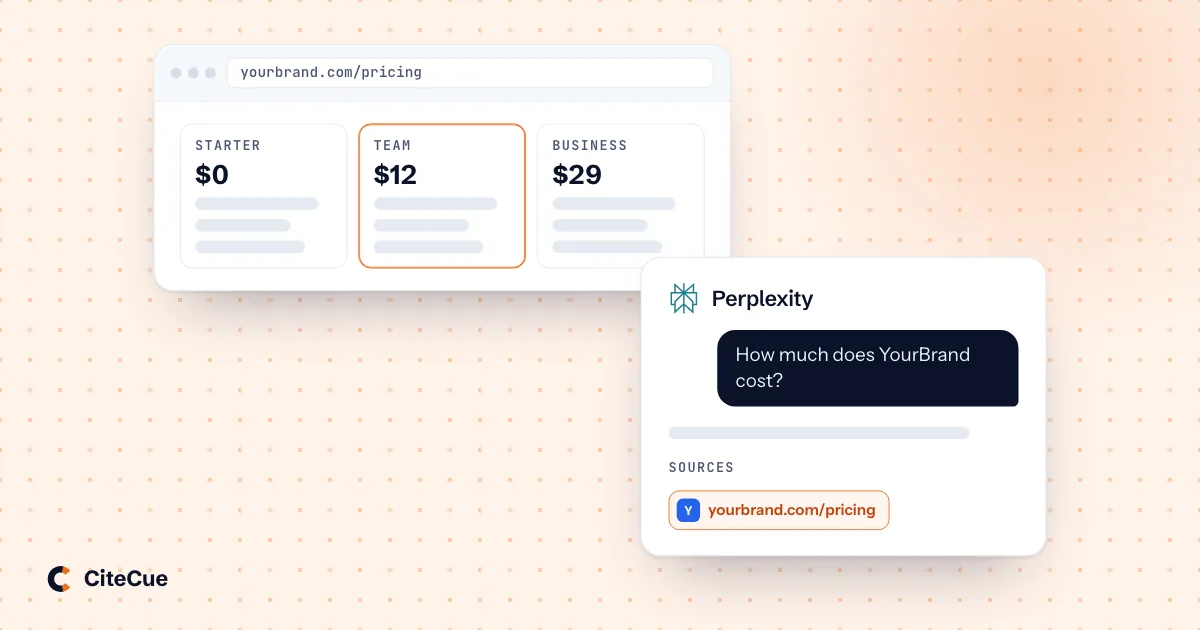
A useful pricing page lets a buyer and an answer engine state the right price with the conditions that make it true. Show the unit, currency, billing period, plan boundary, and material exclusions beside the number. When pricing is custom, explain the inputs that determine the quote and the next step. The goal is an accurate buying answer, not a bare “starts at” figure that creates more questions.
Price questions are unusually high stakes in AI answers. A buyer may ask whether a product is affordable, which plan includes a capability, what the first-year cost looks like, or whether a competitor is cheaper for a specific use case. A correct product description with a wrong price or missing condition can still send the buyer in the wrong direction.
No page can force an AI assistant to quote it or keep every answer current. A clear pricing source gives your team something concrete to inspect when an answer is incomplete, outdated, or misleading.
Map the pricing decisions before designing the table
A pricing table is an interface, not the whole answer. Start with the decisions a buyer needs to make after seeing it.
| Buyer decision | Information that needs to be explicit |
|---|---|
| Can I start? | Free option, trial, minimum commitment, or sales route |
| Which plan fits? | Included capabilities, limits, intended user, and upgrade point |
| What am I actually paying? | Currency, unit, billing period, tax treatment, and required add-ons |
| What changes the price? | Seats, usage, implementation, region, contract length, or support level |
| How do I buy? | Checkout, quote process, procurement contact, or partner route |
This prevents a common mismatch: a page answers “what does the entry plan cost?” while the buyer is really asking “what will it cost for twenty people with the feature we need?” The page does not need to calculate every possible scenario. It should show which inputs change the answer and where a buyer can confirm their case.
Use labels that carry the unit. “$49” is incomplete. “$49 per workspace per month, billed annually” is a claim someone can verify. If a price requires a contract, a deployment service, a minimum quantity, or a particular geography, put that condition beside the number rather than in a distant tooltip.
Make each number survive being quoted out of context
AI answers often compress several pricing facts into a sentence. Write each important price so it stays accurate if the surrounding table disappears.
| Weak price statement | Better price statement |
|---|---|
| “Pro costs $99.” | “Pro is $99 per user per month when billed annually, with a five-user minimum.” |
| “Free trial available.” | “New self-serve customers can start a 14-day trial; no card is required.” |
| “Enterprise is custom.” | “Enterprise pricing is quoted from seat count, deployment requirements, and support scope; contact sales for a written proposal.” |
| “Add-ons available.” | “The compliance archive is a paid add-on for Business and Enterprise plans; it is not included in Starter.” |
The examples are writing patterns, not a template for inventing precision. If your business cannot publish a fixed price, do not pretend it can. Explain the commercial model, the variables the quote depends on, and the route to a decision. A buyer can act on a transparent quote process; they cannot act on a “contact us” button that withholds every useful constraint.
For variable usage pricing, include the measurement and what happens at a threshold. For a promotional price, state who qualifies and the end condition. For a regional price, identify the currency and market. These details reduce the chance that an old campaign, member price, or price in another country becomes the answer to a general question.
Keep product, pricing, and purchase facts aligned
Pricing failures are usually not isolated to the pricing page. The same fact may appear in sales decks, comparison pages, product guides, checkout, in-app upgrade screens, support articles, marketplace listings, structured data, and third-party reviews.
Create one record for every material offer:
| Fact | Source of truth | Repeats to review | Owner |
|---|---|---|---|
| Plan price and billing unit | Billing or pricing configuration | Pricing page, checkout, product markup | Revenue operations |
| Included capability | Plan entitlement definition | Product pages, docs, comparison tables | Product marketing |
| Trial terms | Trial configuration | CTA copy, help center, onboarding | Growth team |
| Quote requirements | Sales policy | Contact form, sales playbook, partner pages | Sales operations |
| Regional terms | Market policy | Locale pages, reseller listings, invoices | Regional operations |
The record is not busywork. It turns “an AI answer said the wrong thing” into a traceable question: which public source is wrong, which one is stale, and who can correct it?
Content freshness for AI search covers event-driven reviews. Pricing should use those triggers especially aggressively: plan changes, new discounts, expiring promotions, new add-ons, currency changes, new regions, and changes to the quote process all deserve a cross-surface check.
Use structured data as a consistency check, not a pricing strategy
Structured data can describe a real purchasable offer for supported Google Search features. It does not turn a confusing pricing page into a reliable answer or create an AI citation guarantee.
For eligible product and merchant pages, Google's current merchant-listing documentation distinguishes active, strikethrough, and member prices. Its product-snippet documentation specifies offer price and currency fields, with availability and date-related fields where applicable. Those details matter only when they match the offer a buyer can actually access.
Do not stretch ecommerce markup over a software pricing grid simply because it has numbers. Choose structured data that accurately matches the page and the supported search feature you are pursuing. Generate volatile fields from the same commercial source that renders the visible price, then compare the result after every material pricing change. The guide to structured data and AI answers explains why markup can clarify a page without controlling selection in an AI response.
Google's current generative AI search guidance says its AI features build on core Search systems and advises useful content with a clear technical structure. It also warns against special AEO or GEO tricks. Treat a pricing page as a buyer resource first: public, crawlable, internally linked, and honest about its limits. Those fundamentals do not guarantee appearance in a generative answer.
Test the price questions buyers actually ask
Run a focused set of questions that exposes price errors before a buyer does. Include branded questions that test factual accuracy and unbranded questions that test the relevant consideration set.
Examples to adapt:
- What does Brand A cost for a ten-person team that needs feature X?
- Does Brand A offer a free plan or trial, and what are its limits?
- Which plans include feature X at Brand A and Brand B?
- Is Brand A available to buy in [market], and which currency applies?
- What should a buyer expect to provide for an Enterprise quote?
Keep the plan, market, company size, and required capability in the prompt. A broad “How much does Brand A cost?” question may produce a technically true but commercially useless answer. Store the exact wording so you can distinguish a changed response from a changed question.
Use CiteCue's AI visibility monitoring to retain a dated record of the pricing question, complete response, cited sources, and competing alternatives. When an answer is wrong, tie the correction to the specific offer and source that caused it. The team can then assign the commercial or content change, record its release date, and inspect later results against the same buyer question.
Do not credit a revised pricing page for one favorable answer. Check repeated results, inspect the cited sources, and log other relevant changes such as a campaign ending or a competitor updating its plan. The purpose is to make commercial facts more reliable, not to manufacture a price comparison win.
Give the buyer a path from price to confidence
A pricing page earns its place in an AEO program when it helps someone answer the next question after the number: what is included, will it fit my situation, and how do I proceed?
Make the facts complete enough to quote accurately, keep related pages synchronized, explain custom pricing honestly, and monitor the buyer questions most likely to expose a costly mistake. If your price pages also need different languages or market terms, use the multilingual AEO guide to separate language from regional availability and pricing facts.