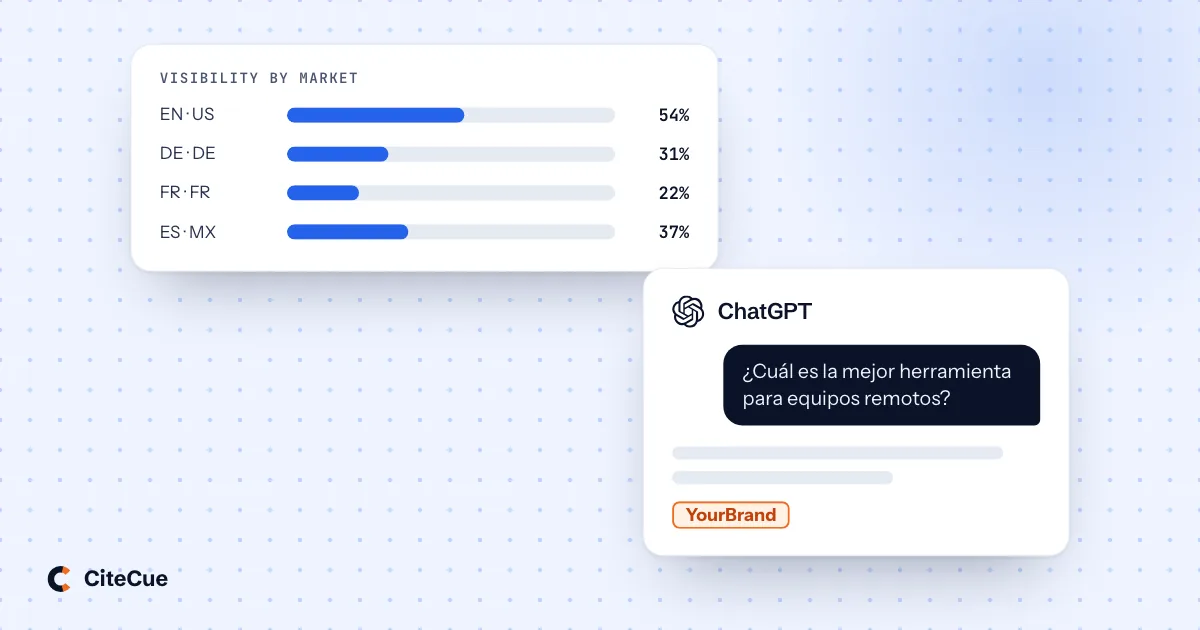
Multilingual AEO means checking whether AI answers understand your business correctly in each language and market you serve. Start with the local facts that change a buying decision, publish clear locale pages for those facts, and measure native-language buyer questions separately. A translation that preserves words but loses availability, pricing, regulation, or product context is not a useful localized answer.
Many international teams run one English visibility program and assume the result represents every market. It rarely does. A buyer in Madrid may ask a different comparison question from a buyer in Mexico City. A French-language answer may need different compliance or support information than an English-language answer. The same product name can sit in a different category, compete with different brands, or have a different purchase path by country.
The objective is not to force identical answers everywhere. It is to give each audience accurate, useful evidence and then inspect how answer engines describe that evidence in the questions that matter locally.
Separate language, country, and market before writing pages
Language and market are related, but they are not interchangeable.
| Dimension | What changes | Example |
|---|---|---|
| Language | The reader's wording, terminology, and explanation | English vs. French product guidance |
| Country or region | Availability, tax, legal, currency, support, and delivery details | Canada vs. France pricing and support route |
| Market segment | Use case, buyer role, competitor set, and proof needed | Agency buyer vs. in-house marketing team |
Start with a market-fact sheet for every audience you actively serve. Record the product name, category language, availability, eligible plans, price display, support language, local requirements, key integrations, and the appropriate contact or purchase route. Give each field an owner and an event that triggers review.
This avoids a common failure: translating an English landing page while leaving a local buyer with a promise the company cannot fulfill in that market. It also gives the content team a source of truth when regional product pages, help content, partner listings, and AI answers disagree.
Google distinguishes multilingual sites from multi-regional sites in its current international site guidance. A multilingual site offers content in more than one language; a multi-regional site explicitly targets people in different countries. Many businesses are both. That distinction is useful for AEO because the first question is whether the buyer needs a different language, a different fact set, or both.
Localize the decision evidence, not only the interface
Navigation labels and marketing headlines are easy to translate. The harder and more valuable work is localizing the information a buyer uses to decide.
For every important market page, review these questions:
- Does the product name or category need a local term to be understood?
- Are prices, currencies, tax treatment, plan availability, and contract terms accurate for this market?
- Do examples use local workflows, regulations, integrations, and units where relevant?
- Does the page name the support language, implementation route, and local contact path?
- Are claims backed by evidence that applies in this country or region?
- Do comparison pages include the alternatives a local buyer actually considers?
Some material can remain global. A technical architecture guide may be accurate everywhere. Other material must be regional: a shipping policy, availability statement, reseller list, privacy requirement, payment method, or product certification. Make the boundary clear instead of giving every page a vague “availability may vary” footnote.
Google's people-first content guidance asks publishers to create substantial, reliable content that serves an intended audience. It does not prescribe a localization template or an AI-ranking formula. It is still a useful test: would someone in this market have enough specific information to finish the decision without translating the page back to English or asking sales to correct it?
Give each locale a stable public route
When language or regional versions genuinely differ, give readers and crawlers a consistent way to reach them. Google recommends different URLs for different language versions rather than changing page language only through cookies or browser settings. It also warns that automatic redirects based on presumed language can prevent users and search engines from reaching all versions.
For a localized page set, check that:
- Every intended version has a stable, public URL.
- Each page is accessible without a location-dependent redirect.
- Readers can choose another available language or region from the page.
- The visible primary content and navigation make the page language clear.
- Canonical tags point to the preferred URL for that version.
hreflangannotations identify the self-reference and the related language or region variants, or the equivalent sitemap implementation is accurate.- The locale URLs in the sitemap and internal links match the URLs that users can actually visit.
Google's localized-versions documentation says that HTML, HTTP headers, and sitemaps are equivalent methods for communicating language and locale variants to Google. Use the one your site can maintain reliably; duplicating all three adds maintenance without a documented Search benefit. These signals help Google understand locale relationships. They do not guarantee inclusion in a Google AI feature or an answer from another platform.
Treat a locale page as a real page, not a switchable rendering mode. A page that only changes after a client-side setting or IP lookup may look correct to one visitor while remaining difficult for a crawler or a buyer who needs another locale. The AI crawler access guide explains why discovery, crawl permission, indexing, retrieval, and citation are separate checks.
Build native-language prompt sets
Directly translating the English monitoring prompt is a starting point, not a complete measurement plan. Buyers use local categories, abbreviations, constraints, and comparison habits.
Build a small matrix for each language-market combination:
| Buyer stage | Prompt job | Example briefing question for the local team |
|---|---|---|
| Discovery | Learn the category language | What would a buyer naturally call this solution? |
| Evaluation | Test fit and constraints | Which local requirements change the shortlist? |
| Comparison | Test the real alternatives | Which brands does this market compare us with? |
| Validation | Check factual representation | Which availability, pricing, or trust fact must be correct? |
| Action | Test the next step | How does a buyer ask where to buy, try, or get support? |
Ask a native speaker or the local customer-facing team to review the prompts. They should remove literal translations that nobody uses, separate a country-specific requirement from a generic question, and flag wording that assumes the desired answer.
Keep the prompt wording stable once it becomes a measurement series. If the local team changes a prompt because it was unclear, record the change and begin a new series rather than treating it as a continuation of the old one. The guide to choosing prompts for AI visibility tracking explains how buyer decisions, rather than keyword volume, should define the set.
Diagnose a language gap before translating more content
If the brand appears in English but not in another language, another translation may not be the first fix. Inspect the exact answer and its sources first.
| Observation | First question | Likely owner |
|---|---|---|
| Wrong local price or availability | Which public page or third-party source supplied it? | Revenue operations or regional product marketing |
| Brand is absent from a local comparison | Does the local site answer the comparison criteria? | Local content and product marketing |
| Answer cites an old language version | Is the current variant reachable, linked, and marked correctly? | Web or SEO team |
| Capability is described with English-only terminology | Is the local explanation understandable and current? | Localization and documentation team |
| Correct answer gives no local next step | Can a reader find the right trial, reseller, or support path? | Growth or regional operations |
Save the result, source list, diagnosis, owner, and later check together. CiteCue's Prompts Monitoring retains the complete answer for each tracked question, while Citations & Competitors helps teams see which sources and brands were used. Add a confirmed content or technical gap to Content Fixes so the local team can prioritize the change and check later scans instead of reacting to one screenshot.
Do not claim that a new page caused a later change because the dates align. Answers vary, engines change, competitors publish, and local sources can update independently. Look for repeated movement in the same language-market prompt set, then compare it with the page and source changes you recorded.
Keep the international program small enough to maintain
You do not need every page in every language on day one. Start with the markets that have a real product, sales, or support commitment and the pages that answer high-consequence buyer questions.
Give each market a compact operating record:
- an owner for market facts and approval;
- the public URLs that serve those facts;
- a reviewed native-language prompt set;
- a log of material product, policy, pricing, and source changes; and
- a recurring review of the AI answers where wrong information would create real friction.
That is a sustainable multilingual AEO program: accurate local information, explicit page relationships, and measurement that respects how buyers actually ask. It gives answer engines better public evidence without pretending that a language tag, a translation vendor, or a single scan can guarantee a recommendation.
For a documentation-specific workflow, read How Product Documentation Supports AI Visibility. For teams rebuilding locale URLs or templates, use the website redesign AEO migration checklist to preserve evidence and validate the production result.