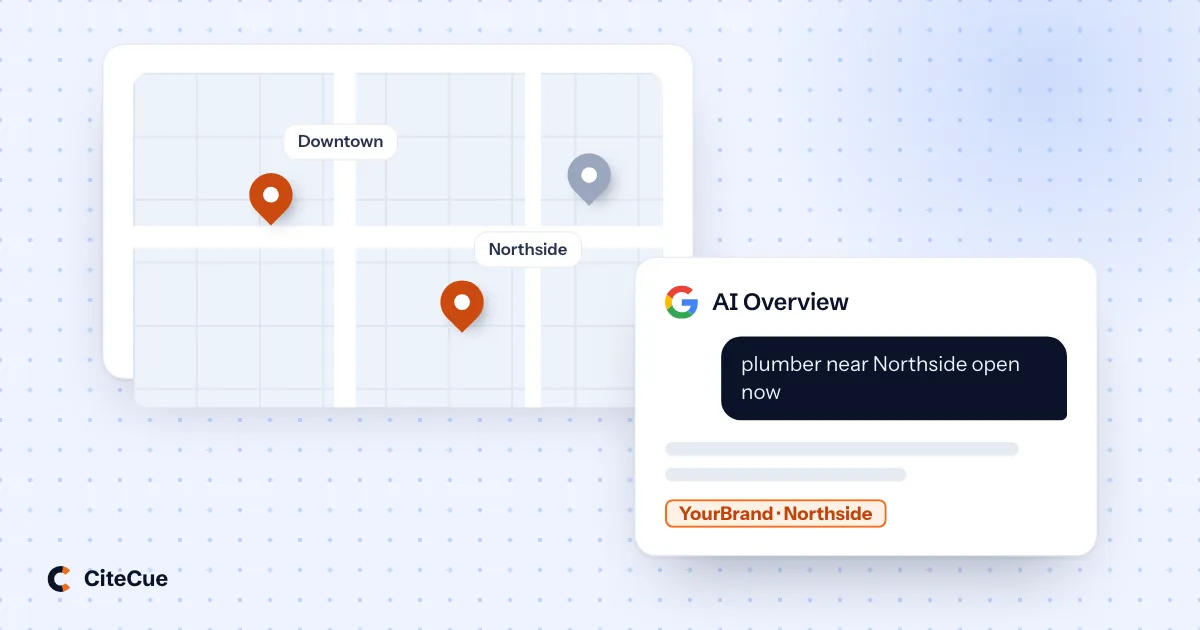
Local answer engine optimization starts with a practical question: can an AI answer send a customer to a business that actually serves their location and need? Give each branch and service area clear public facts, keep business profiles aligned with those facts, and test questions that name a place. Measure whether the answer identifies the right business, scope, hours, and next step alongside whether it mentions your brand.
A local mention can be commercially useless even when it looks like a visibility win. An assistant might recommend the right company but the wrong branch, describe a mobile service as a walk-in shop, or repeat hours that apply to a different department. The customer still cannot complete the task.
This guide is for businesses with physical locations, mobile teams, delivery areas, or a mixture of those models. Its job is to make geographic promises accurate and testable. For adapting content across languages and countries, use the separate multilingual AEO guide.
Separate a branch address from a service boundary
Start with how customers receive the service. “Located in Bratislava” can mean a shop someone can visit, an office that dispatches a mobile team, or a registered address with no customer access. Those meanings should not be interchangeable on your site.
Define three things for each operation:
| Question | Fact to publish | Common mistake |
|---|---|---|
| Can a customer visit? | Customer-facing address, access instructions, and appointment requirements | Presenting an administrative address as a walk-in location |
| Can the business travel or deliver there? | Actual cities, districts, or postal areas served, with relevant exclusions | Treating the headquarters city as the entire service area |
| Can this location perform the requested service? | Branch-specific services, departments, and restrictions | Copying the full company's service list onto every branch page |
Use an operational record, maintained by the people fulfilling the service, as the starting point. A map pin is not proof that a technician can take an appointment in the surrounding district. A national brand promise is not proof that every branch offers every service.
Consider a fictional business, Northbank Cycle Care. Its Old Town workshop accepts booked repairs, while its mobile team serves Petržalka on weekdays. A generic “bicycle repairs across Bratislava” headline loses the distinction. A useful explanation tells customers which route applies to their location, what repairs each team handles, and where to book.
Give branch facts one owner and several verified destinations
Create one fact record per real branch or service operation. It should be detailed enough for the website team, profile manager, and receptionist to give the same answer.
Include the public business name, location identifier, customer-facing address where applicable, service boundary, phone, booking URL, services, accessibility details, and appointment rules. Distinguish shop opening hours from telephone coverage, delivery windows, and technician availability. “Open until 18:00” should not silently mean “the call center answers until 18:00.”
Then map the destinations that repeat those facts:
| Fact | Operational owner | Public destinations to check |
|---|---|---|
| Regular and exceptional hours | Branch manager | Branch page, business profile, booking system |
| Service coverage and exclusions | Dispatch or fulfillment lead | Service-area page, profile, quote form |
| Services available at a branch | Local operations lead | Location page, service pages, partner directories |
| Contact and appointment route | Customer service lead | Website, profile, directory listings |
| Move, closure, or temporary disruption | Operations lead | Old and new location pages, profiles, customer notices |
Make a material change trigger a review of those destinations. A new workshop address should not reach the website while the booking page and major directory still send people to the old entrance. Keep a record of what changed, who approved it, and which public surfaces were checked. The content freshness guide explains how to maintain changing facts without changing dates for appearance alone.
Make business profiles describe the real operation
Review the official profiles you control before adding more location content. Google's business representation guidelines require a name that reflects the real business and a precise address or service area. They also set eligibility conditions for physical offices and service businesses. Do not manufacture a local presence by adding an office that customers cannot use or stuffing services into the profile name.
For businesses that travel to customers, Google's service-area guidance distinguishes service-area businesses from hybrid businesses that also receive customers at their address. If customers are not served at the business address, Google says to remove that address from the public profile and enter the service area. Apply the guidance for your actual operating model rather than creating a profile for every town you hope to reach.
Accuracy also matters independently of AI answers. Google's local ranking guidance recommends complete, current information, including relevant hours and categories. Its local ranking factors concern Google Maps and Search; they are not a published recommendation formula for every AI assistant.
Check profiles after a move, service change, or holiday schedule update. A website correction does not update a separate profile automatically. If an assistant cites a third-party listing, inspect that listing too before assuming the first-party page is the source of the error.
Build location pages around a usable local decision
A branch page should let a customer decide whether to visit, call, or book that branch. Put the relevant services, public location, hours, access instructions, and contact route on the page. Link from the branch directory to each real location, and from shared service pages to the branches that offer the service.
A service-area page has a different job. Explain the boundary, how appointments or deliveries are assigned, any travel charge or quote condition you publish, and what happens when a customer is outside the area. If several towns share the same service, rules, and booking route, one useful coverage page may answer the question better than a separate page for every town.
Use a separate page when the local decision materially differs. Different access instructions, services, staff, collection points, or booking rules can justify a branch page. Replacing only the city name does not. Google's doorway-abuse policy includes substantially similar pages and city-targeted pages that funnel readers through an unnecessary intermediate step. Review whether the page itself helps someone complete the local task.
For public physical locations, Google's LocalBusiness structured-data documentation says to describe each location with the appropriate business type and supports properties such as hours and telephone. Keep the markup aligned with that location's visible facts. Its rich-result requirements include a physical address, so do not invent an address or expose a private residential address merely to fill a schema field.
Structured data can support ordinary Search features. Google's current generative AI guidance says it is not required for generative AI search and that there is no special schema markup for inclusion. A valid local-business object does not guarantee an AI recommendation.
Test a named place and a real customer constraint
“Near me” depends on who is asking and which product surface they use. OpenAI's current ChatGPT search documentation says it may use an approximate location inferred from an IP address, optional device location, and relevant memory to tailor searches. A result from one person's chat is therefore a local observation with context, not a universal result for your city.
For recurring monitoring, state the city, district, or postal area explicitly. Also distinguish discovery from factual validation:
| Test purpose | Illustrative prompt | What to inspect |
|---|---|---|
| Discovery | Which bicycle repair services make home visits in Petržalka, Bratislava? | Providers named and whether their coverage fits |
| Branch selection | Where can I book an e-bike repair in Bratislava Old Town? | Correct branch, supported repair, and booking destination |
| Branded validation | Does Northbank Cycle Care accept walk-in repairs at its Old Town workshop? | Appointment rule and supporting source |
| Boundary validation | Does Northbank Cycle Care offer mobile repairs in Trnava? | Whether the answer invents coverage outside the fictional service area |
| Schedule validation | What are Northbank Cycle Care's Old Town workshop hours on Mondays? | Workshop hours rather than dispatch or telephone hours |
These examples describe the fictional business above; adapt them to your actual services and facts. Keep branded validation results distinct from unprompted discovery when interpreting visibility. A prompt that supplies your name tests what the assistant says about you, not whether it independently finds you.
CiteCue's Prompts Monitoring keeps the complete answer behind each tracked question. Use explicit local wording and stable prompt groups to compare recurring observations. Those checks do not recreate every resident's device location, conversation history, or live interface. Supplement them with documented checks in the consumer product when you need to inspect a map, a local listing, or a personalized result. Record the location context and time with the answer.
Trace the wrong local answer to a fixable source
Read the entire answer and open its cited pages. A correct mention can coexist with an incorrect address, schedule, service, or booking destination. Track those factual errors alongside mentions and citations.
Suppose the fictional mobile team is described as offering Sunday visits. If the answer links to a directory, confirm whether that page actually states Sunday availability. The citation alone does not prove where every sentence originated. If the directory is wrong, request a factual correction through its normal process. If your own branch page combines workshop and mobile hours, clarify that distinction at the source.
Citations & Competitors helps identify the domains appearing in tracked answers. Use that evidence to decide where to investigate, while keeping the reason for an assistant's selection uncertain. Route confirmed gaps to the owner who can repair them: operations for coverage, the profile manager for a listing, or the web team for branch content and links.
Add supported website changes to Content Fixes with the affected location, prompt, source, and acceptance condition. “Clarify mobile service hours and verify the booking route” is actionable. “Improve local GEO” leaves the owner guessing what success means.
Review local accuracy when the operation changes
Make branch openings, closures, moves, service changes, and exceptional schedules explicit review triggers. Before a change takes effect, verify the first-party page, official profile, appointment route, and the important listings that already appear in answers.
After publication, check the page and customer task immediately. Then inspect later answers using the same named-place questions. Report technical completion and answer observations separately: the new hours can be correct on the site while an assistant still repeats the previous schedule. A later correction is useful evidence of recovery, but timing alone does not establish which edit caused it.
The deliverable is a maintained local fact record connected to public pages, profiles, and repeatable checks. It gives customers a better chance of reaching the right team and gives your business a concrete way to detect when an AI answer sends them elsewhere.