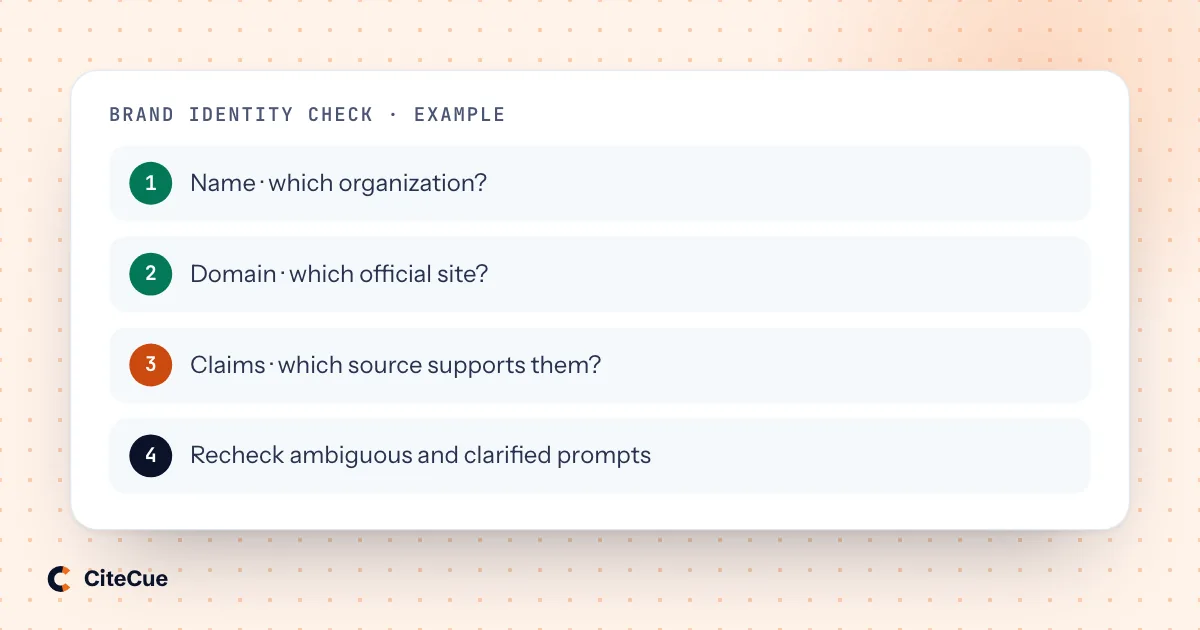
When an AI answer confuses your brand with another company, preserve the response and identify which facts belong to which business. Check the cited domains, publish a clear first-party identity record, correct profiles that point to the wrong organization, and review the markup connecting your official pages. Then repeat the original ambiguous question as well as a separate set that names your domain or category.
An answer can use your exact brand name and still describe someone else. The headquarters belong to a namesake, the products belong to a former owner, and the link goes to your homepage. A mention counter may look healthy while a buyer receives a description you cannot stand behind.
This is an identity problem: determining which real organization or product a name refers to. In search terminology, separating those entities is called disambiguation. The practical job is to make the distinction checkable and investigate where it breaks. General authority building has a different purpose; the guide to earning third-party authority covers independent reviews and references.
Confirm whether the answer describes another business
Start with the exact response, not a general complaint that “AI gets us wrong.” Save the prompt, engine, date, relevant settings, answer text, and source links. Mark the disputed sentences and identify which organization, if any, each one describes.
Use several identity clues together:
| Clue | What to compare | What it can reveal |
|---|---|---|
| Official domain | Answer links and source domains versus your canonical website | Another company with the same name |
| Product or service | What the answer says the business sells | A namesake, category error, or product-company mix-up |
| Location | Headquarters or operating area versus your public facts | Another regional business or the wrong branch |
| People and ownership | Named leaders, parent, or subsidiary | A relationship that was misread or became outdated |
| History | Former names, acquisitions, discontinued products | A real historical fact presented as current |
A wrong fact does not automatically establish a namesake collision. If an answer invents a feature for the correct company, investigate a factual error. If it repeats the old price for the correct product, investigate freshness. If the evidence is mixed or absent, keep the cause unresolved.
If a report relies only on matching a brand-name string, a namesake could be counted as a mention. Treat that as a measurement limitation to review in the answer text. Preserve the original result and add a human identity assessment rather than silently changing the historical score.
Create a compact public identity record
Establish the facts your team can verify about its own business. Put a readable explanation on the appropriate homepage, About page, or product page, and use it consistently where those facts recur.
The record should distinguish:
- the public organization name and its official website;
- the registered legal name where relevant to identifying the business;
- the product name, category, and intended customer;
- the organization that owns or operates the product;
- former names and the dates or conditions under which they applied;
- real parent, subsidiary, or acquired-product relationships; and
- official external profiles that describe the same organization.
Write the relationship in ordinary language. “Harbor is workforce scheduling software operated by Harbor Scheduling Ltd” is more useful than a slogan that never says whether Harbor is a company, a product, or a marketplace. This sentence is a fictional example, not a recommended legal name or a claim about an existing business.
Keep organization and product facts separate when they differ. A parent company's founding year need not be the product's launch year. A group's office address need not be the service location. An acquisition does not necessarily make the acquired product an alternate name for the buyer.
When a former name remains useful to customers, explain the history and link to the current page. Do not erase the connection or present every historical alias as a current brand. Make sure the support and purchase routes help a reader confirm that they have reached the intended business.
Trace disputed claims through their cited sources
Open each cited page and inspect the passage that could support the disputed claim. Record its domain, title, subject, publication or review date when available, and whether it actually refers to your organization.
OpenAI's current ChatGPT search guidance notes that results and citations can be incomplete, outdated, or incorrect and recommends checking whether the cited source supports the answer. A citation is a place to investigate; it does not prove that every sentence came from that page.
Use this fictional example. Two unrelated businesses both use the name Harbor: a scheduling product at harbor-scheduling.example and a furniture retailer at harbor-furniture.example. An answer to “What does Harbor sell?” describes shift planning, gives furniture delivery terms, and links to the scheduling website.
The useful investigation looks like this:
| Answer claim | Source check | Assessment |
|---|---|---|
| Harbor manages staff schedules | Scheduling site's product description supports it | Correct for the software product |
| Harbor offers furniture delivery | Retailer's policy supports it | Belongs to the unrelated namesake |
| Both services are operated by one company | No source establishes that relationship | Unsupported relationship; do not infer a merger |
Now look for a bridge that could confuse a reader: a directory with the retailer's description and the software domain, an old profile with a recycled social handle, or your own About page that omits the product category. These are investigation hypotheses. Finding an error on one profile does not prove that it caused the assistant's complete response.
CiteCue's AI citation tracking helps identify domains appearing in tracked answers. Keep the source comparison beside the full response so the team can distinguish an actual page mismatch from a plausible explanation with no supporting source.
Correct profiles and references at the right organization
Prioritize public records that visibly confuse the two businesses, especially when they appear in the affected answers. Check the official website link, description, category, logo, contact details, and parent-product relationship on profiles your team controls.
For a third-party page, prepare a narrow factual correction: the field that is wrong, the value it should contain, and a public first-party source supporting the change. Ask the publisher to correct the mistaken association. A legitimate namesake's profile may be entirely accurate; it should not be removed or changed to describe your business.
Google provides a specific process for a knowledge panel that describes you. Its knowledge-panel feedback instructions ask representatives to explain the error and provide publicly accessible URLs supporting the suggestion. Verification affects the feedback process, and Google reviews the evidence. This process concerns that Google surface; it does not edit answers across other assistants.
Use the correction channel that matches the source. A business listing, review profile, marketplace page, knowledge panel, and editorial article may have different owners and procedures. Avoid submitting a broad request to “improve our AI ranking” when the concrete problem is a wrong domain or an incorrect ownership statement.
Make identity markup reflect the real relationships
Review the markup after the visible identity record is correct. Google's Organization documentation says organization markup can help it understand administrative details and distinguish organizations in Search. It documents properties including name, alternateName, legalName, url, logo, and sameAs.
Apply those fields carefully:
| Property | Appropriate use |
|---|---|
name |
The organization name used on the site |
alternateName |
A genuine common name for that same organization |
legalName |
Its registered name when applicable and different |
url |
Its official website |
sameAs |
A reference or profile identifying that same entity |
Schema.org defines sameAs as a reference that unambiguously identifies the item. A partner, a similarly named company, a parent, or a page that merely mentions you is not automatically the same entity. Do not use identity links as a list of sites you want associated with your brand.
Inspect the rendered output as well as the CMS fields. Plugins and templates can emit conflicting organization records, old domains, or a product's social profile on the company's node. Confirm which real subject each record describes before merging or removing anything; multiple correctly linked entities can be legitimate.
For this investigation, a clean schema validator is an implementation check. Google does not require structured data for generative AI search, and successful validation alone cannot demonstrate that an assistant selected the right business. Inspect actual responses after publishing the correction. The guide to structured data and AI answers covers the wider implementation questions.
Test ambiguous and clarified questions separately
Keep the original question that exposed the confusion. If you replace every ambiguous prompt with a detailed description of your own company, you remove the failure from the test rather than demonstrating recovery.
Build a small diagnostic panel with distinct jobs:
| Prompt type | Fictional example | What it tests |
|---|---|---|
| Ambiguous brand | What does Harbor sell? | Which entity the assistant selects with minimal context |
| Category-qualified brand | What does Harbor workforce scheduling software do? | Whether a category resolves the ambiguity |
| Domain-qualified brand | Describe the business at harbor-scheduling.example | Whether the official domain resolves the identity |
| Relationship | Who operates Harbor workforce scheduling software? | Whether product and company are connected correctly |
| Unbranded discovery | Which scheduling tools suit a small shift-based team? | Whether your product is considered without supplying its name |
Use the same wording, engine, locale, and documented context across repeated checks. A clean diagnostic conversation can help isolate the wording, while a separate consumer-product check can document the conversation context a buyer supplied. Do not pool those observations as if they were identical conditions.
AI prompt monitoring in CiteCue retains the full responses to tracked questions. Review the selected entity as well as the mention. Sentiment & Brand Risk provides claims worth checking, while a human verifies which organization those claims concern. Neither a positive tone nor an exact name match settles identity on its own.
For your internal audit, label each response correct, another entity, mixed, or unresolved, and document the reason. Report these assessments separately from the platform's headline visibility metrics. Keep the raw observations available when the classification needs review.
Close the correction with evidence and an owner
Assign one owner to maintain the identity record and coordinate the fixes. Product marketing can verify the company-product relationship, the web team can repair visible pages and markup, and the profile owner can correct external listings. Use CiteCue's content fix workflow for confirmed page gaps with the affected answer, source, and acceptance condition attached.
Verify controlled changes immediately: the correct domain is linked, the visible description is accurate, and the markup reflects the intended entity. Then inspect later answers across both the ambiguous and clarified prompt groups. Do not promise a universal refresh time or treat one favorable response as a permanent correction.
Close the investigation when its stated condition is met, or record what remains unresolved. “The directory now identifies the software company correctly” is one verified outcome. “The assistant selected the correct company in these later observations” is another. Keeping both precise makes the result useful even when the assistant's behavior varies.
The aim is accurate recognition: the right organization, the right product, and relationships that a reader can check. A shared name may remain ambiguous, but your public evidence and your measurement process should make the distinction explicit.