
Key takeaways
- Mentioned in 39 of 100 AI answers, up from 7: a gain of 32 percentage points.
- Both tested AI engines named the app after 3 months, up from one.
- Lead discovery with a task people can try today, and explain the roadmap separately.
About the company
A live choice-board app inside a wider AAC vision
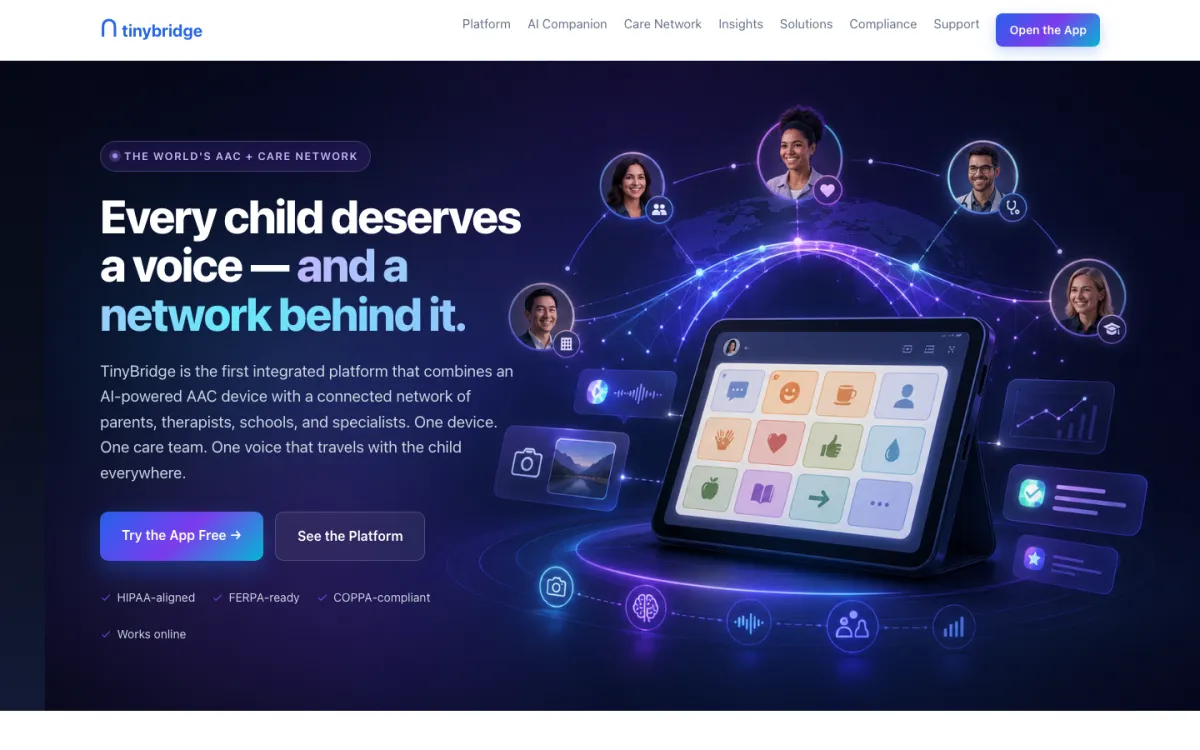
TinyBridge builds for the people around every child who needs a voice. It combines an AI-powered AAC — augmentative and alternative communication — app with a connected network of parents, therapists, schools and specialists.
The part that is live today is Choice Boards: snap a photo of a menu, shelf or scene, and the app builds a tappable, speakable board in seconds. Other features are clearly marked by stage — a menu reader and voice and camera control in private beta, visual schedules and personalized stories coming, and a new LAMP-based AAC device in closed beta.
That honesty about stages is useful, and it raises the stakes: an AI answer that describes a coming feature as available sends a family to look for something they can't use yet.
The problem
A family needs to know what the app does today, not the roadmap
A broad care-network vision is harder to evaluate than one concrete task. A family asking how to turn a photo into a communication board needs the available app, what they can try, and where to begin.
AI answers about AAC tend to list established symbol-based apps and dedicated devices. A newer product with a genuinely different first task — a board built from a photo — has to be described precisely to show up, and accurately to be useful when it does.
That question shouldn't require anyone to interpret a roadmap first:
“Which apps can turn a photo of everyday objects into a communication choice board?”
The goal
Connect TinyBridge with practical choice-board discovery questions while keeping descriptions of current and planned capabilities accurate.
The approach
Lead with the live task, check what answers promise, and make the first board concrete
Begin with the live use case
Prompts Monitoring tracks unbranded prompts about photo-based communication boards and visual choices. Availability and feature checks run separately, outside the discovery denominator.
25Unbranded discovery prompts
Check what the answer promises
Sentiment & Brand Risk compares generated descriptions with the product's published feature status and flags any live-versus-planned mismatch, instead of counting every positive mention as a win.
2AI engines tested each round
Make the first task concrete
Content Fixes prioritizes a short photo-to-board walkthrough, an example and a clear path to the app, with roadmap material kept distinct.
50Answers per measurement round
The fixes
What a family needs before trying the app
The live task, first
Photo-to-board choice boards described as available today, with the steps in order: take a photo, the board is built, tap a choice to speak it.
Feature status on every capability
Live, private beta and coming labels kept beside each feature on the pages AI reads, so an answer can't merge the roadmap into the product.
A clear first step
The route to try the app on its own, separate from the device waitlist and the wider platform story.
The results
TinyBridge went from 7 to 39 mentions per 100 AI answers in 3 months
More mentions mean more routes to the product. They don't show the descriptions are accurate, which is why the claims are reviewed on their own.
Where it landed:
- 7 → 39 AI answers mentioning TinyBridge, per 100
- 39% Of answers naming the brand after 3 months
- 1 → 2 tested AI engines naming the app
- Mention rate, over 3 months.
- +32 pts
- Of answers named TinyBridge after 3 months.
- 39%
- Organic growth over the same window.
- +370%
The same 25 unbranded discovery prompts ran once across two AI engines at baseline and again after 3 months: 50 completed answers per round. Figures are from those fixed prompt sets, not from every AI answer or from attributed revenue.