
Key takeaways
- Mentioned in 61 of 100 AI answers, up from 10: a gain of 51 percentage points.
- All three tested AI engines named the brand after 4 months, up from one.
- Discovery is organized around the work a call has to trigger: a qualified lead, an appointment, an order or a human handoff.
About the company
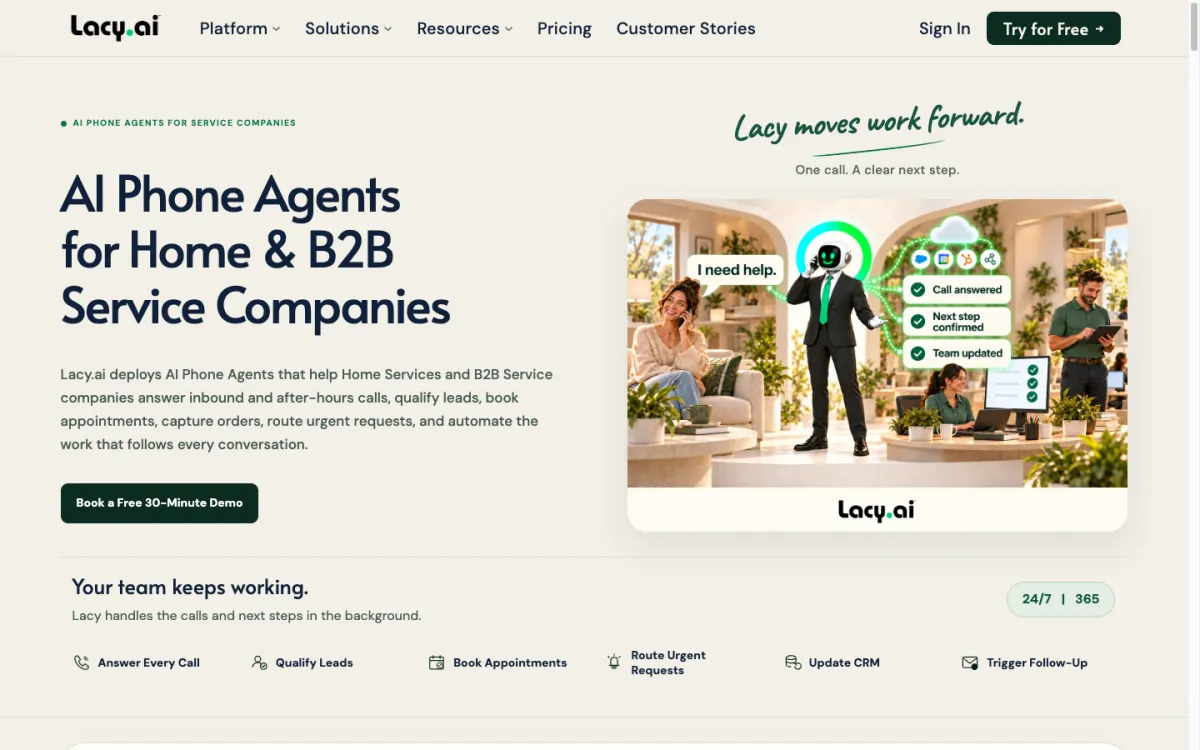
AI phone agents that move the work after the call
Lacy builds AI phone agents for home services and B2B service companies. They answer inbound and after-hours calls, qualify leads, book appointments, capture orders and route urgent requests, around the clock.
Its emphasis is on what follows the answer: each call becomes captured context and a clear handoff — a booking, a team alert, a CRM update or a follow-up — based on the workflow a team configures. The actions and connected systems depend on each team's setup.
Its own customer stories show the range: San Francisco Ice uses it for order intake and repeat customers, and K2 Roofing for roofing lead intake, estimate requests and follow-up.
The problem
Buyers describe the problem, not the product
A roofing team taking storm calls and a supplier taking repeat orders both need someone to pick up the phone. What happens after the answer is different for each, and that is where they decide.
A buyer might search for missed roofing leads or after-hours order taking long before typing "AI phone agent". A general product description can explain the technology and still leave those practical questions open.
The opportunity is to connect each question with what the agent collects, what it does next, and when a person takes over:
“Which AI phone agents can qualify roofing leads after hours and send the details to our team?”
The goal
Increase Lacy's presence in relevant AI answers and help service operators recognize which call-handling problems the product can address.
The approach
Start from the operational question, check the explanation, then build a route to the demo
Start with the operational question
Prompts Monitoring monitors unbranded prompts about after-hours lead intake, estimate scheduling, repeat orders and urgent-call routing, each tagged by industry and task so a strong total can't hide a weak use case.
25Unbranded discovery prompts
Review the explanation alongside the mention
Sentiment & Brand Risk checks whether answers describe Lacy accurately, including the difference between answering a call and carrying out a configured action, against its product documentation.
3AI engines tested each round
Build a route from question to demonstration
Content Fixes prioritizes focused pages that walk through the caller's request, the details collected, the resulting action and the human fallback, each tied to an example and a demo request.
75Answers per measurement round
The fixes
What a service operator needs to see before booking a demo
One page per call-handling job
Roofing lead intake, repeat-order capture and urgent-call routing each explained on its own, in the operator's terms rather than the technology's.
The handoff, spelled out
What the agent collects, which action it triggers — a booking, a CRM update, a team alert or a follow-up — and when a person takes over.
Setup stated plainly
That actions depend on configured workflows and connected systems, so an answer never promises an integration a team hasn't set up.
The results
Lacy went from 10 to 61 mentions per 100 AI answers in 4 months
Which operational questions improved matters more than the total: roofing lead intake and repeat-order handling lead to different sales conversations.
Where it landed:
- 10 → 61 AI answers mentioning Lacy, per 100
- 61% Of answers naming the brand after 4 months
- 1 → 3 tested AI engines naming the brand
- Mention rate, over 4 months.
- +51 pts
- Of answers named Lacy after 4 months.
- 61%
- Organic growth over the same window.
- +470%
The same 25 unbranded discovery prompts ran once across three AI engines at baseline and again after 4 months: 75 completed answers per round. Figures are from those fixed prompt sets, not from every AI answer or from attributed revenue.