A product launch needs an answer-engine plan before the announcement goes live. Define the questions buyers will ask, publish one clear source for every launch-critical fact, make those pages discoverable, and record a category baseline you can compare with later scans. The goal is to learn whether AI answers understand the new product, not to manufacture a launch-day visibility win.
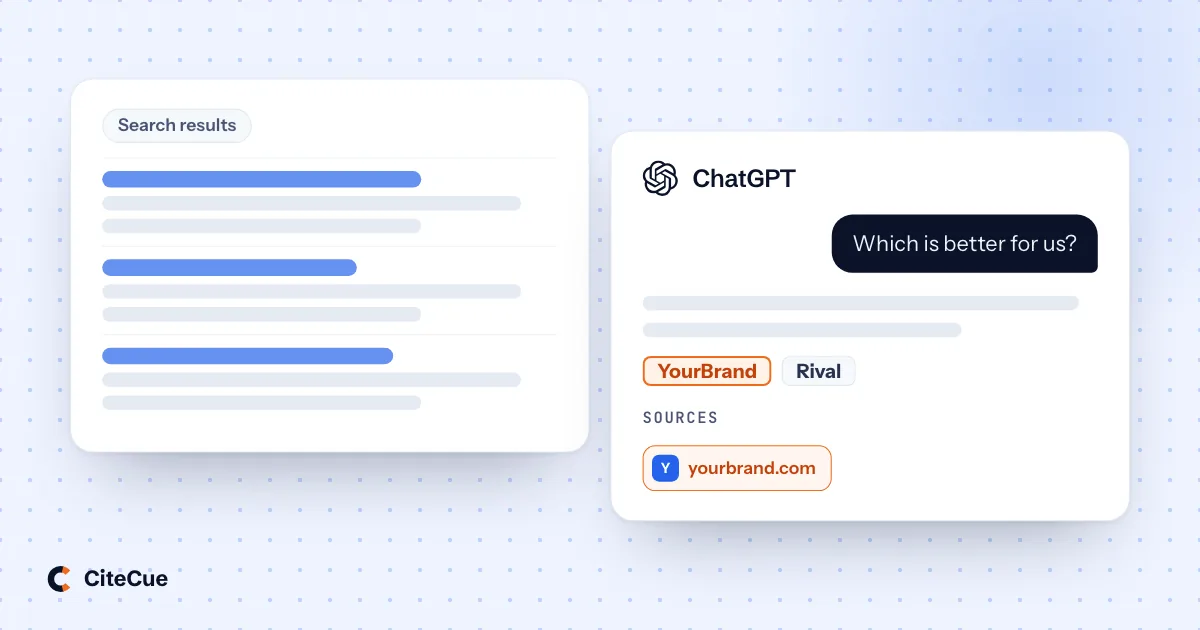
Most launch plans already cover positioning, press, email, sales enablement, analytics, and search. They often leave one public interface unassigned: the AI answer that summarizes the category, compares the new product, or explains whether it fits a buyer's constraint.
That answer may not change on launch day. Crawlers need to discover the new pages, indexes and retrieval systems need to process them, and independent sources may still describe the old market. A useful AEO launch plan creates accurate public evidence and a measurement record so the team can see what catches up, what stays wrong, and what needs another fix.
Start with a launch question map
Do not begin by writing an “AI-optimized” version of the press release. Begin with the decisions a buyer will make after hearing the news.
Build a compact question map across five jobs:
| Buyer job | Example question | Evidence the answer needs |
|---|---|---|
| Understand | What does this product do? | Plain definition, category, intended user |
| Compare | How is it different from the existing plan or a competitor? | Named criteria, current alternatives, limitations |
| Qualify | Does it support my use case, region, integration, or company size? | Eligibility rules, supported features, boundaries |
| Trust | Is this available now, and what proof supports the claims? | Release status, method, documentation, customer or technical evidence |
| Act | How do I try, buy, migrate, or contact the right team? | Price or sales route, setup steps, requirements |
Keep the set small enough to review answer by answer. Include unbranded discovery questions, branded fact-check questions, and comparisons where a real buyer would reasonably consider alternatives. The broader guide to choosing prompts for AI visibility tracking explains how to separate those intents without turning a keyword list into dozens of near-duplicate prompts.
Run category and competitor questions before launch, even if the unreleased product cannot appear yet. This is a market baseline, not a product score. It shows which brands and sources currently define the conversation. Start a separate product series when the product becomes public so a change in the subject does not masquerade as a trend.
Create a single answer map for launch facts
Launch copy often spreads the same fact across a homepage banner, press release, product page, documentation, pricing table, help center, and third-party listings. If those surfaces disagree, an answer engine has to choose between them.
Create an answer map with one row per fact that could affect a recommendation:
| Fact | Canonical public page | Owner | Review trigger |
|---|---|---|---|
| Product name and category | Product overview | Product marketing | Positioning change |
| Availability and regions | Availability or release page | Product operations | Region rollout |
| Price and plan limits | Pricing | Revenue operations | Packaging change |
| Supported integrations | Documentation | Product | Integration release or retirement |
| Security or compliance status | Trust center | Security | Attestation change |
| Migration requirements | Implementation guide | Customer success | Process change |
The canonical page should state the fact directly, include the qualifications that prevent overclaiming, and link to deeper evidence where needed. Other pages can summarize it, but they should point back to the maintained source instead of creating a second version of the truth.
This is where an answer map differs from a messaging document. Messaging tells the team how to describe the launch. The answer map tells readers and machines where a claim can be checked, who keeps it current, and what event requires an update.
Publish evidence, not a cluster of thin launch pages
One complete product page plus useful documentation is usually a stronger launch asset than a page for every slight query variation. Google's current guidance for generative AI features says its AI search experiences build on core Search systems and recommends original, useful, people-first content with a clear technical structure. It also cautions against producing many query variants primarily to influence rankings or generative answers.
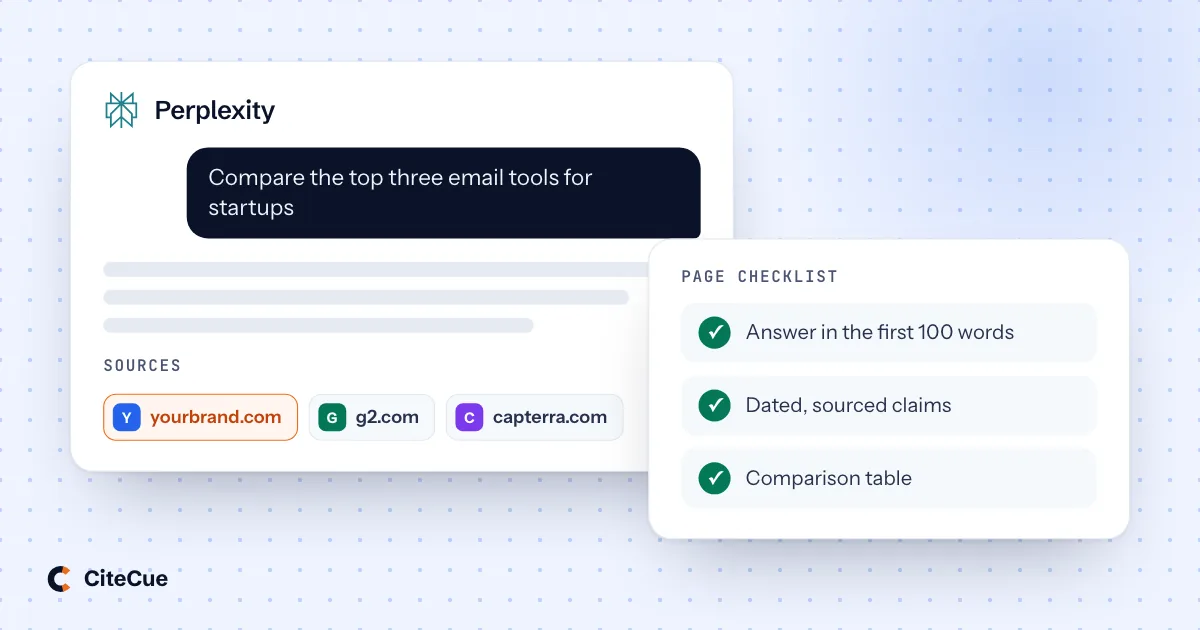
For a launch page, useful evidence can include:
- a direct product definition near the beginning;
- a clear list of intended users and poor-fit cases;
- specific capabilities with links to documentation;
- current availability, pricing route, and material limits;
- comparisons based on named, verifiable criteria;
- a demonstration, method, or technical explanation behind performance claims; and
- a visible publication or update date when timing matters.
Do not turn aspirations into capabilities. “Designed to reduce setup work” is a positioning claim. “Sets up in ten minutes” is a measurable performance claim that needs a defined test and evidence. If a number comes from a beta sample, say who was measured, how, and what the result does not establish. Citation-ready content is content whose claims remain accurate when a sentence is lifted out of the page.
Independent launch coverage can help buyers corroborate a product, but it must remain independent. Give journalists, analysts, reviewers, partners, and customers accurate source material; do not manufacture consensus or script praise. The guide to building third-party authority for AI search covers the legitimate routes.
Make the launch pages discoverable and internally connected
A complete page still needs a stable public route. Before launch, verify the final production URL rather than assuming a staging preview will translate correctly.
Check that:
- The page returns the intended status without authentication.
- Its canonical tag points to the final public URL.
- Robots directives and CDN rules allow the search and AI crawlers you intend to serve.
- The XML sitemap contains the canonical URL and a truthful modification date.
- The product page links to pricing, documentation, trust material, and setup instructions.
- Existing category, comparison, and navigation pages link to the new product where it helps a reader.
- The title, H1, description, visible copy, structured data, and documentation use the same product name and status.
- Retired preview URLs redirect or disappear instead of competing with the launch page.
Google's sitemap documentation explains that sitemaps help discovery but do not guarantee crawling or indexing. OpenAI's current publisher guidance says public sites can appear in ChatGPT search and advises allowing OAI-SearchBot when publishers want content available for summaries and snippets. These are platform-specific facts, not proof that every answer engine discovers or selects a page in the same way.
Use CiteCue's AI Readiness to check crawler access, sitemap coverage, index signals, and connected referral tracking. A clean readiness check means the technical prerequisites look right; it does not promise a mention or citation.
Measure launch understanding in stages
Trying to force one “launch visibility score” to answer every question makes the result hard to interpret. Split measurement into stages with different decisions.
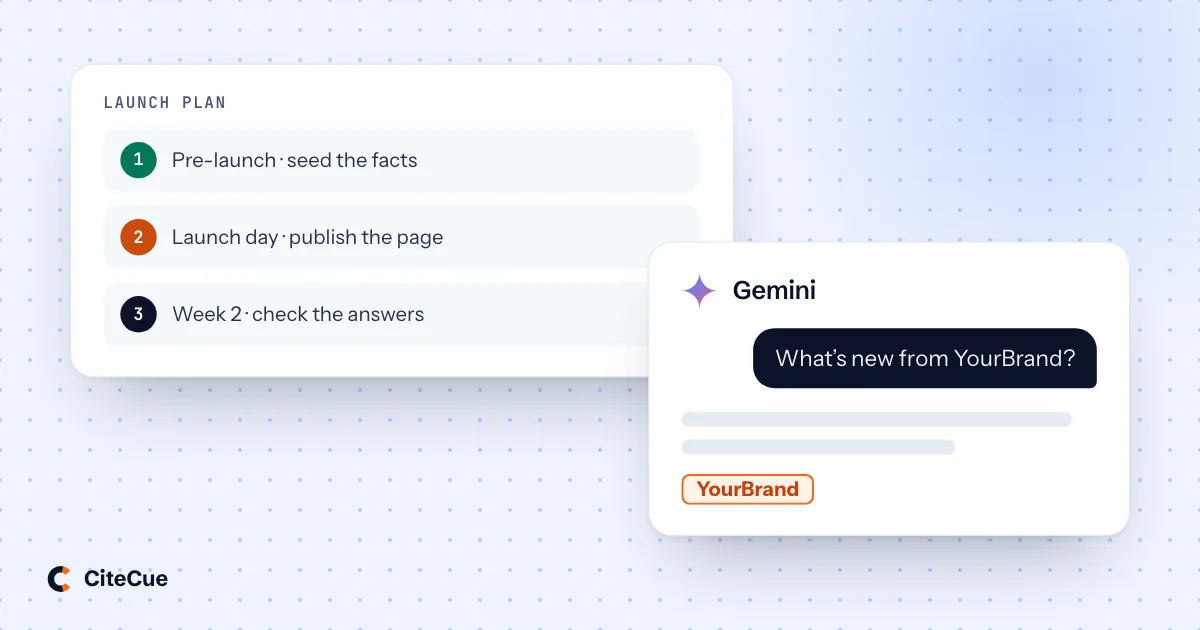
Before launch: category baseline
Run the category, use-case, and competitor questions from the launch map. Save the complete answers, cited sources, brands, positions, and dates. Note which sources consistently shape the category.
Launch week: factual QA
Add branded questions about what the product is, whether it is available, who it serves, what it costs, and what it supports. Treat wrong or missing facts as investigations. Check the cited source and public page before assuming the answer engine is the only place that needs to catch up.
Following weeks: repeated comparison
Repeat the same prompt set and inspect trends across multiple runs. Watch for:
- the product beginning to appear in relevant consideration sets;
- citations moving toward current official or credible independent sources;
- old product facts continuing to surface;
- different engines describing the product differently; and
- competitors remaining ahead because their evidence answers a question yours does not.
Do not claim the launch caused a change just because the dates line up. AI answers vary, competitors publish, sources change, and discovery takes time. Record other meaningful events beside the scan history: a documentation update, new review, pricing change, crawler fix, or corrected third-party page.
In CiteCue, keep the launch questions together in Prompts Monitoring and retain the dated response behind every result. When the evidence supports a change, add it to the Content Fixes queue with an owner and a later verification point. That launch history remains reviewable after the announcement cycle has ended.
Route each failure to the right owner
An absent mention does not automatically require another blog post. Diagnose the failure before creating work.
| Observed problem | Likely first owner | First check |
|---|---|---|
| Launch page cannot be fetched | Web or SEO | Status, robots, CDN, rendering |
| Product is described with an old fact | Product marketing | Canonical page and conflicting sources |
| Competitor is cited for a missing capability explanation | Product or content | Documentation and evidence gap |
| Price or availability is inconsistent | Revenue operations | Source-of-truth page and feeds |
| Product appears but for the wrong audience | Positioning team | Category and intended-user language |
| Answer is accurate but gives no next step | Growth or web | Pricing, trial, contact, and setup paths |
Keep a launch ledger with the prompt, answer, cited source, diagnosis, owner, shipped change, and next review date. This preserves the chain from observation to verification. It also stops several teams from “fixing” the same symptom in different places.
The launch deliverable is a maintained evidence system
AEO does not turn a launch announcement into an instant recommendation. It gives the launch a public fact base, a discovery path, and a repeatable way to inspect how answer engines represent the product.
Hand the post-launch owner four artifacts: the buyer-question map, the canonical answer map, the technical QA record, and the launch ledger. Continue measuring the same questions, update facts at their source, and prioritize gaps that repeatedly affect real buyer decisions.
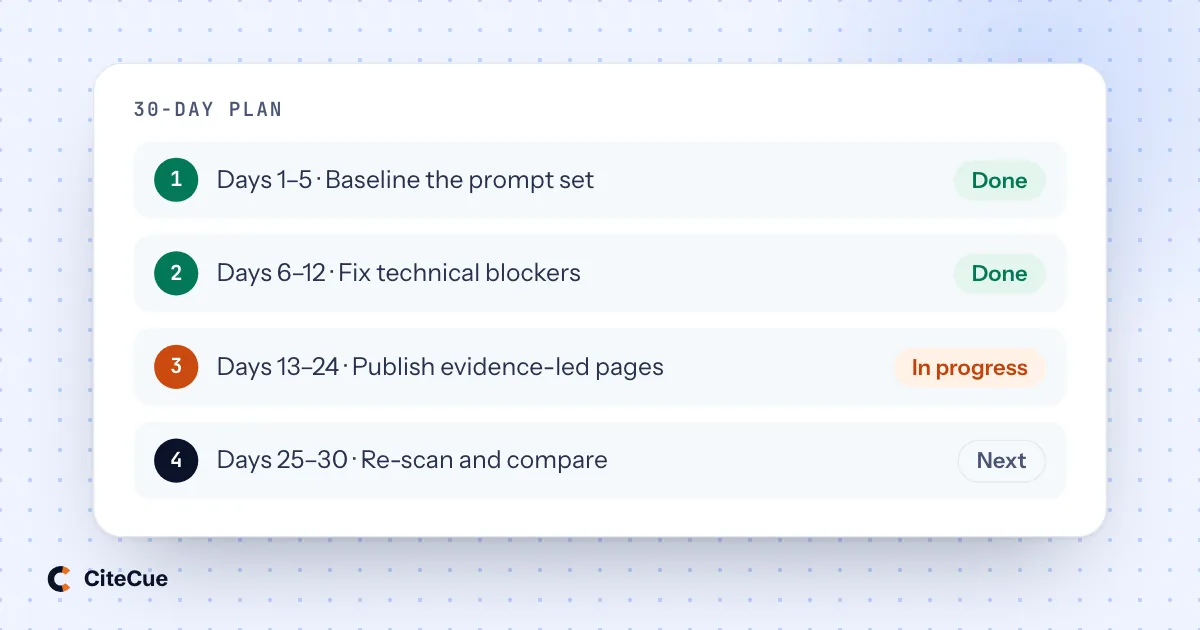
If the launch also includes a site migration, use the website redesign AEO checklist for redirects, URL mapping, and before-and-after QA. For a broader month-long program around the launch, adapt the 30-day SEO and AEO plan after preserving this launch-specific baseline.